
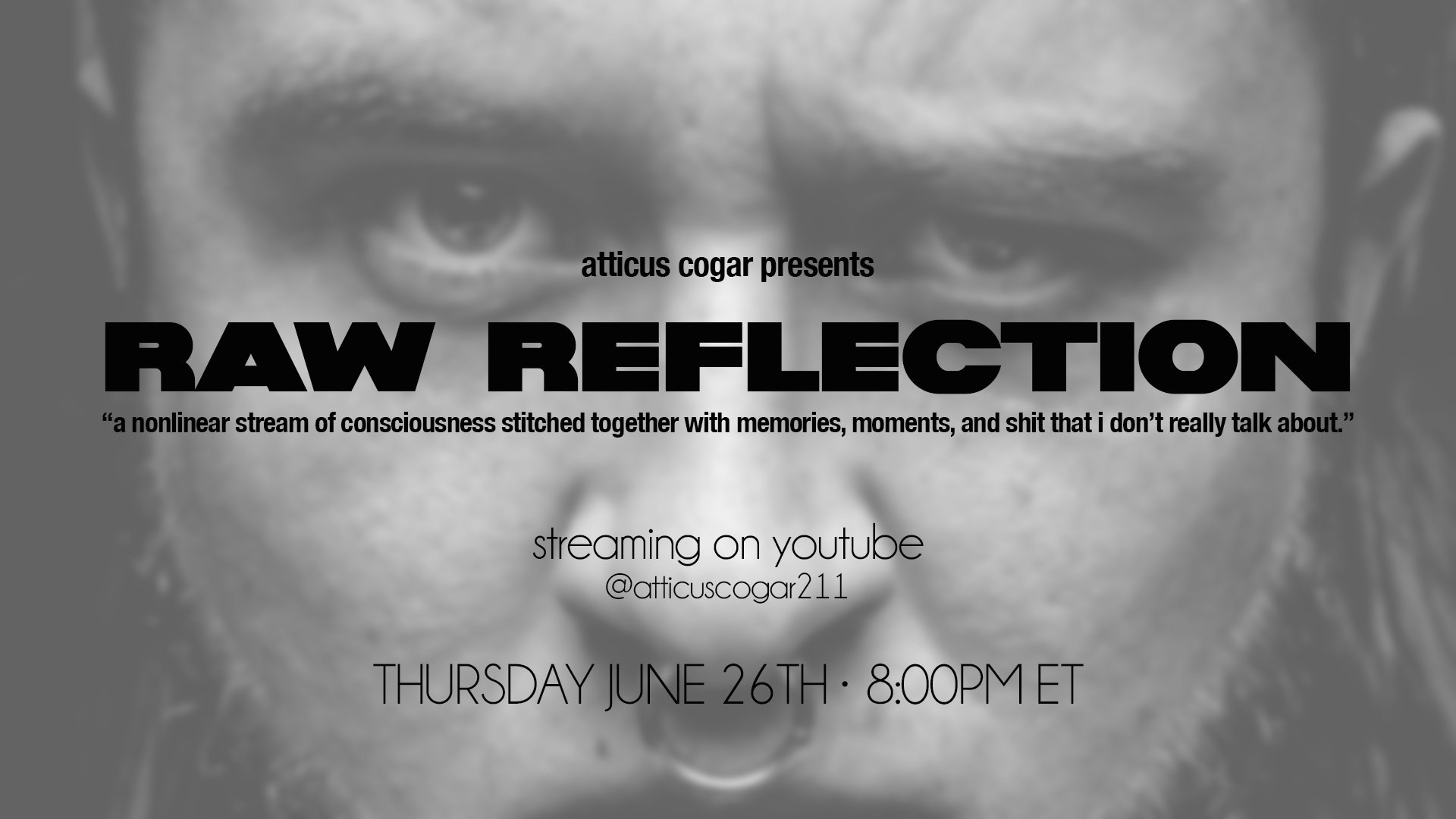
This past Thursday, Atticus Cogar celebrated ten years as a professional wrestler. He released a documentary “Raw Reflection” on YouTube coinciding with his milestone, which features never before seen footage, as well as a sit down Q&A.
In the documentary, Atticus touches on his departure and return to GCW, his retirement from deathmatch wrestling, the breakup of 44OH, and more.
Why did you choose to retire from deathmatch wrestling on the ICW stage rather than concluding that chapter by winning Tournament of Survival 10, and bringing it full circle?
It’s pretty interesting. For me, retiring at TOS 10, it wouldn’t have been full circle, at least not the way you think. Yes, TOS 6 definitely changed the trajectory of my deathmatch career at the time. It helped me stop being seen an up-and-comer, and it helped me matter among the names in deathmatch wrestling who matter. It was also a breakout moment for Alex Colon in my opinion. People still chant 3 peat at him to this day. That match definitely became something bigger than both of us. But honestly, I had my full circle moment with Alex Colon when I wrestled him at Wrestling Revolver in 2024. It was one of the most violent matches I’ve ever had in my whole career. If you haven’t seen it, you should definitely check it out. But that gave me the closure that I needed when it came to that chapter.
As for why I chose to end my deathmatch career at ICW, it just felt right, you know? I poured so much of myself into that company and had some of the most brutal deathmatches I’ve ever had in that company. I’m still the longest reigning American Deathmatch Champion in that company’s history, and when I was no longer a part of GCW, Danny, kind of just still welcomed me with open arms. That became the company that I kind of gave everything to. When it comes to ultraviolet wrestling specifically, he gave me the space to tell my story and also gave me the trust when he didn’t need to, to tell my story. So, ICW, having, you know, Otis, and Bobby Beverly back to back? It just seemed like the right environment to do it because there’s not much left for me to do when it comes to my goals specifically in deathmatch wrestling. So, now that I’m back in GCW, I’m using this platform to evolve and show a different side of what I can do and a different side of what I can create. You know, like, deathmatch wrestling built my name, but it’s what I’m doing now and what I’m gonna do next that, in my opinion, truly redefines it.
At any point did you believe a return to GCW was off the table?
Yeah, I mean, if you would have asked me like a year ago, I definitely would have said a return to GCW was off the table. That all happened very unexpectedly, very fast. Of course I thought, like, you know, what it might look like. I will say, leaving GCW was definitely one of the more humbling experiences of my career. It forced growth. I think on both sides. I think Bret and I almost spent four years apart evolving in our own ways. So I think that that time apart allowed for something new and something really special to happen. Being back in GCW it means the world to me. I genuinely, at least in this moment in time, am enjoying what I’m doing, arguably, on the biggest independent wrestling platform in the world. I don’t really have a lot of restrictions, or like creative restrictions placed on me there, so I’m able to like, really take risks, and I’m able to push things as far as I want them to go.
What were the key factors that led to the decision to bring 44OH to an end, and how did that chapter shape you?
Ending 44OH was definitely one of the hardest decisions we’ve ever had to make, but it was necessary. You know, that faction was more than just a wrestling angle. It was real. It felt close. It was close. It was a movement. It was a shared struggle. It was like the hunger to leave a mark that couldn’t be erased. But the truth is, when you have 10 people in a faction, all with their own personalities and their own creative visions and their own goals, it becomes nearly impossible to keep everyone aligned. Not everyone agreed, and not everyone was willing to compromise, and I think that creative tension can be a good thing, but when it stops being collaborative and starts becoming personal, it kind of breaks the foundation. Some people chose to distance themselves because I returned to Game Changer Wrestling, and that’s heartbreaking, but it’s out of my control. But 44OH left a legacy. You know, we made people feel something real. Clinging on to the faction for the sake of nostalgia, in my opinion, just keeps you stuck, and I’ve said it a million times, I refuse to run in place. That’s with the character, and in my real life, I refuse to run in place. And right now, I’m focused on building something new that reflects the person that I am now. 44OH is always going to be a huge part of my story, but it’s no longer the chapter I need to be writing.
 PWPonderings